





Update on Pioneering Pastors in Ethiopia
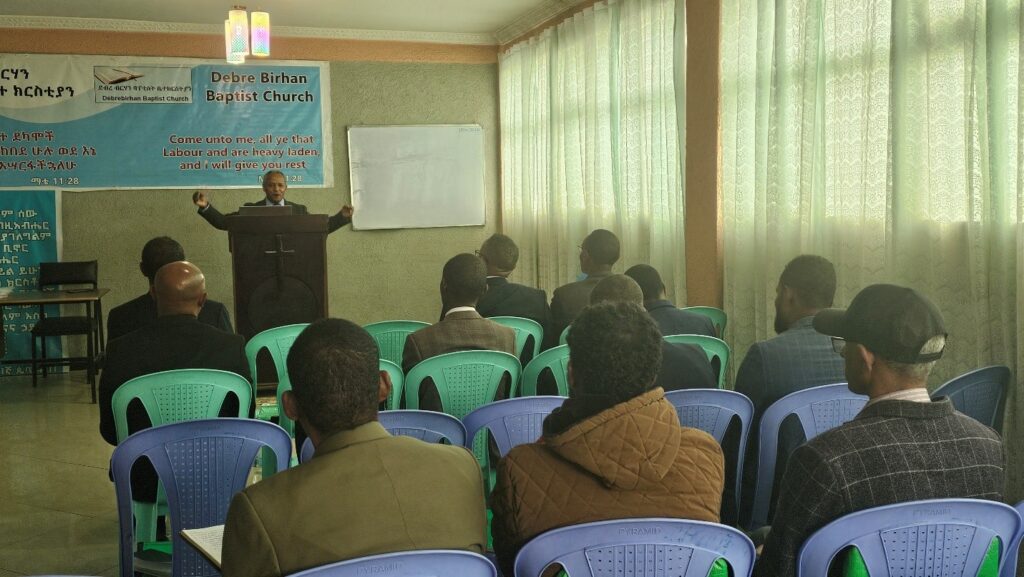
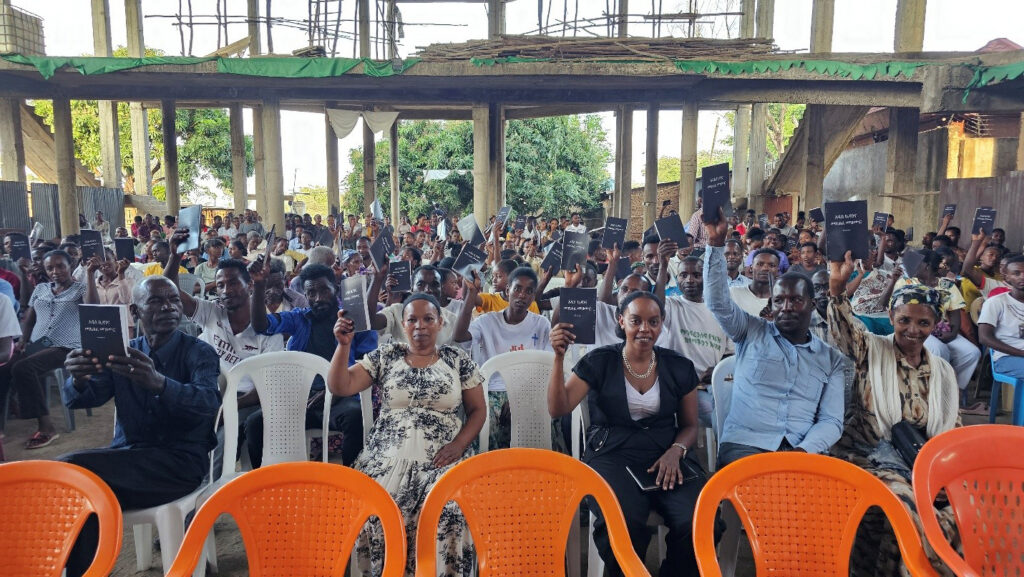
With Pastor Haile Emiru’s help we were able to speak with the Tabernacle-supported pastors in Ethiopia via Zoom while they were together at meetings in Debrebirhan.

Pastor Haile Emiru
Pastor Haile was converted in teenage from Ethiopian Orthodoxy, trained as a science teacher and sent by the government to various parts of the country. Wherever he went he also witnessed and preached, and house churches were formed as a result.
For this the communist regime then in power imprisoned him four times, between 15 days and 15 months at a time. Later he pastored a large Baptist church in Addis Ababa, once again planting churches. His active evangelism among Muslims led to a number of death threats, eventually forcing him to seek refuge in the UK.
Being familiar with the writings of CH Spurgeon, he visited the Tabernacle and soon settled among us, being active in outreach and was a great encourager of others. He followed the LRBS course and also pursued advanced studies in New Testament Greek. He began translating the New Testament into Amharic with the Trinitarian Bible Society; this has now been published along with the Psalms. He pastored East Dulwich Tabernacle from 2011-15 before moving with his family to the USA.
In trips to Ethiopia promoting this better translation he has, despite the dangers, continued to plant churches.
Pastor Haile has recently been teaching on ‘Holding and Standing for the Truth’ at a series of meetings in Debrebirhan, and had completed seven sessions with a group of church planters and missionaries when we spoke with him.
He has also been teaching how to conduct the Lord’s Supper, weddings, funerals, and child presentation services, commenting that it is important to equip these men so they do not feel they need to call in help from outside.
Few reformed books are available in Amharic, but Pastor Haile has translated and printed Physicians of Souls and Only One Baptism. The Lessons for Life books have been translated, but some further work is needed before they are ready to be printed. As well as being very useful for children’s ministry, Pastor Haile believes they will be of great help to pastors in preparing evangelistic messages.
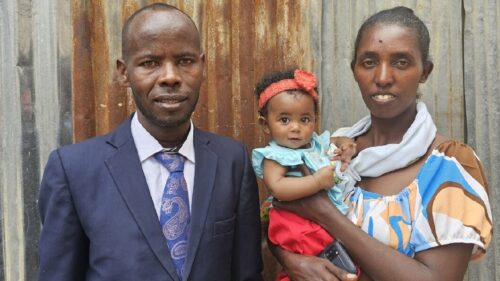
Pastor Merdasa Debela
Pastor Merdasa is pastor of Tede Dildima Baptist Church in Dildima, a region in central Ethiopia.
He has had to deal with unbiblical practices and charismatic teaching. Charismatic influences had brought informality in worship, singing and even shouting to his church. The church is now on its way to biblical worship. They are using a selection of hymns chosen by Pastor Haile and bound together to form a hymnbook. This is in use in all the churches which he is helping. Pastor Merdasa has taught reverent worship, reverent teaching, and reverent preaching.
The church structure and organisation were also previously unbiblical. Many years ago, Pastor Haile translated Dr Masters’ book, Church Membership in the New Testament. Unknown to him, somebody posted it online. Merdasa found this and studied it, and changed everything in the church based on what he read, overturning the previous structure.
Because of this, the church faced great difficulties and almost persecution. One of the changes was to leave their denomination (many churches are part of this denomination), but they have suffered on account of this move. There was a price to be paid: the loss of legal status as a registered church. The government requires a membership of 100 people before a church can register. Registration is necessary to buy a plot of land or to open a bank account.
This problem has been solved with the help of the Debrebirhan church which has made provision for them. The Debrebirhan church is registered, and has been able to extend cover to Pastor Merdasa’s church to allow registration. (The other pioneer churches will face the same problem, and will receive the same help.)
There are currently 26 people meeting at Tede Dildima Baptist Church. They meet in a small building with a corrugated iron roof, capable of holding about 30 people. They are close to this limit once the children who meet with them are included.
The church has land which was left to it by a lady who was the first convert in the area and who gave 200 square metres of her own land. The difficulty is using the land to put up a church building. They are waiting for permission to build on the land, and have employed a lawyer to help them. They do not anticipate problems but there is a delay and it would be unwise to begin building before permission is granted.
They are the first evangelical church in the area. The Tabernacle has agreed to help with the erection of a simple building, and this caused the people to be very happy. They have been discouraged by the delay, but look forward to the time when work can begin.
Pastor Merdasa is involved in evangelism, but is having to deal with false rumours about Christians and some hostility. Years ago, there was a group of so-called Christians which came in and went about the work in an unwise manner, causing a disturbance and making much noise. Pastor Merdasa and his fellowship evangelise one-to-one, inviting people to come and praying that they will.
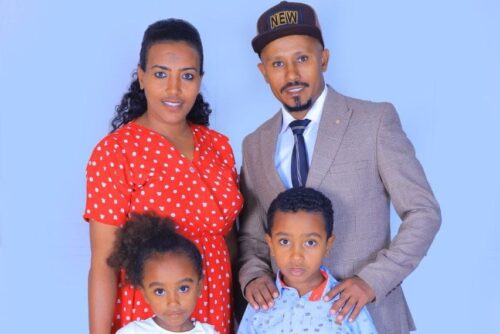
Pastor Gebeyehu Birhanu
Pastor Gebeyehu ministers in Bahir Dar, meaning ‘close to the sea’ (actually a lake called Tana Lake).
It was necessary for Gebeyehu to leave his old church and start a new church. The previous church was unhappy with the new practices which he tried to introduce: reformed worship, and the adoption of the 1689 Baptist Confession of Faith. Following Pastor Haile’s explanation, he also wanted to introduce a second worship service on the Lord’s Day. This decision was unpopular because of tradition. People do not want to go back to church on the Lord’s Day, because it is seen as a day of rest and relaxation.
The previous church wanted youth leaders to be able to lead the service, not just the preacher, and they wanted women to be able to teach. This is a common issue in the country: women teaching has been a tradition in Ethiopia for the last 20 years.
Gebeyehu and his wife left by mutual agreement; they were asked to stay, but they made clear they could not do so without the reforms they were asking to be implemented.
Two families left with them, and others have since joined them. There are now 15 people meeting together in Gebeyehu’s rented house. This can only be a temporary arrangement, as the house can only hold up to 20 people, and their landlord is Orthodox and is not keen that so many should meet in his property.
85% of the local population are Orthodox, who are hostile to Protestants. The remainder are mostly Muslims, with only a few evangelicals. It is not easy to find a meeting place and the need is now urgent. The congregation are mostly farmers with low incomes. The church at Debrebirhan has bought plastic chairs for them.
The church engages in evangelism. They are not allowed to conduct street preaching, but they do one-to-one evangelism and give out tracts and explain the Gospel. Gebeyehu goes with his wife to family members, and also invites people they meet around the town where they can drink tea and talk.
The church holds two services on a Sunday. The Gospel is preached in the morning when new people are more likely to come. They have not yet started holding the Lord’s Supper. The plan is to continue with evangelism and gathering together for meetings on the Lord’s Day and to hold a midweek Bible study and prayer meeting. In the future they will start children’s work.
Some have requested to come and join them from the previous church, but at the moment they do not allow it, in order to maintain good relations with the previous church. In future, if people show they are serious and continue to want to come and are willing to accept the new standards, Gebeyehu will allow them to join.
The area of Bahir Dar is experiencing civil unrest, including fighting nearby. Much of Ethiopia is facing an unsettled situation due to the conflict between Tigrayan forces and the federal government. There are other believers whom Gebeyehu wants to reach, but it is not safe to go to them because they are outside the city.

Pastor Bashayder Zewde
Pastor Bashayder gave up his government work in order to take up pioneering work at a new church in Gachene. There are now nine adults gathering in his house which he owns (the house can fit up to 30 people). Most of the congregation are family members of Bashayder.
They are semi-nomadic people. Most are farmers. There are some who were backslidden but are now coming back to worship. A number of children are also coming who are part of Bashayder’s wife’s extended family. Again, the church at Debrebirhan has provided chairs.
They hope to have their own church building, as there is a negative view of churches that meet in private houses. Believers would be happier joining them in a church building. Local Muslims also prefer to see churches that meet in their own building.
The pioneer church is holding several meetings a week: two Sunday services, a Bible study on Tuesday and a prayer meeting on Thursday. Bashayder visits and evangelises on Wednesdays and Fridays. Local people gather under the shade of trees and chew khat, a widely used mild narcotic.
Bashayder is able to engage with groups of these people and speak to them about the Gospel. Although many are Muslims they are not so hostile when spoken to personally. They carry out their religion by rote, without understanding why they do much of what they do.
The church is trying to find a place to buy but has had some difficulties. One Muslim they approached was not happy to sell land to Christians.
Another urgent need that Bashayder has is for a funeral plot. People ask, “If I join you, where will I be buried?” And without this provision they are unwilling to come. A burial plot could be found on the cheaper, more hilly land outside the city.
Bashayder asks for prayer that the Lord will uphold him in the work.
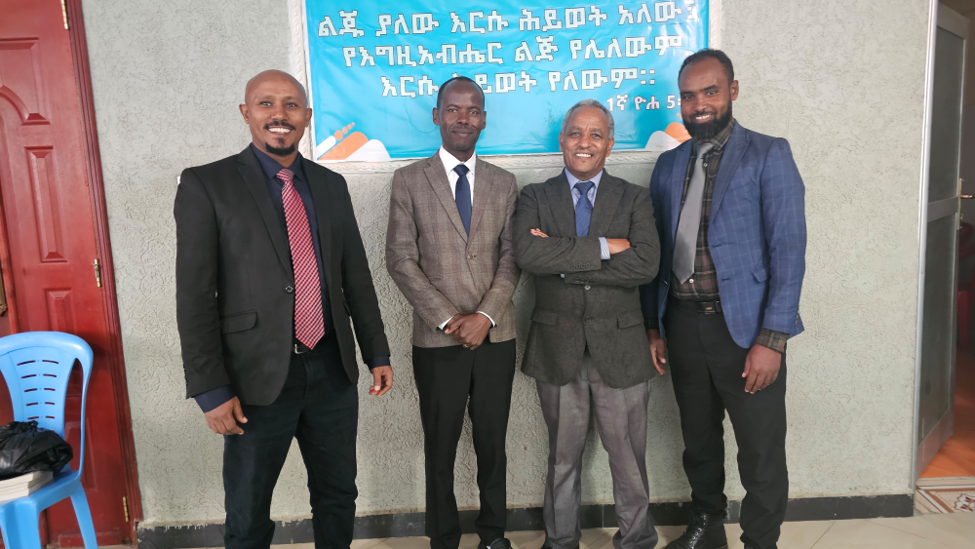
From the left: Pastors Gebeyehu, Merdasa, Haile and Bashayder